Greiner Bio-One's eTrack
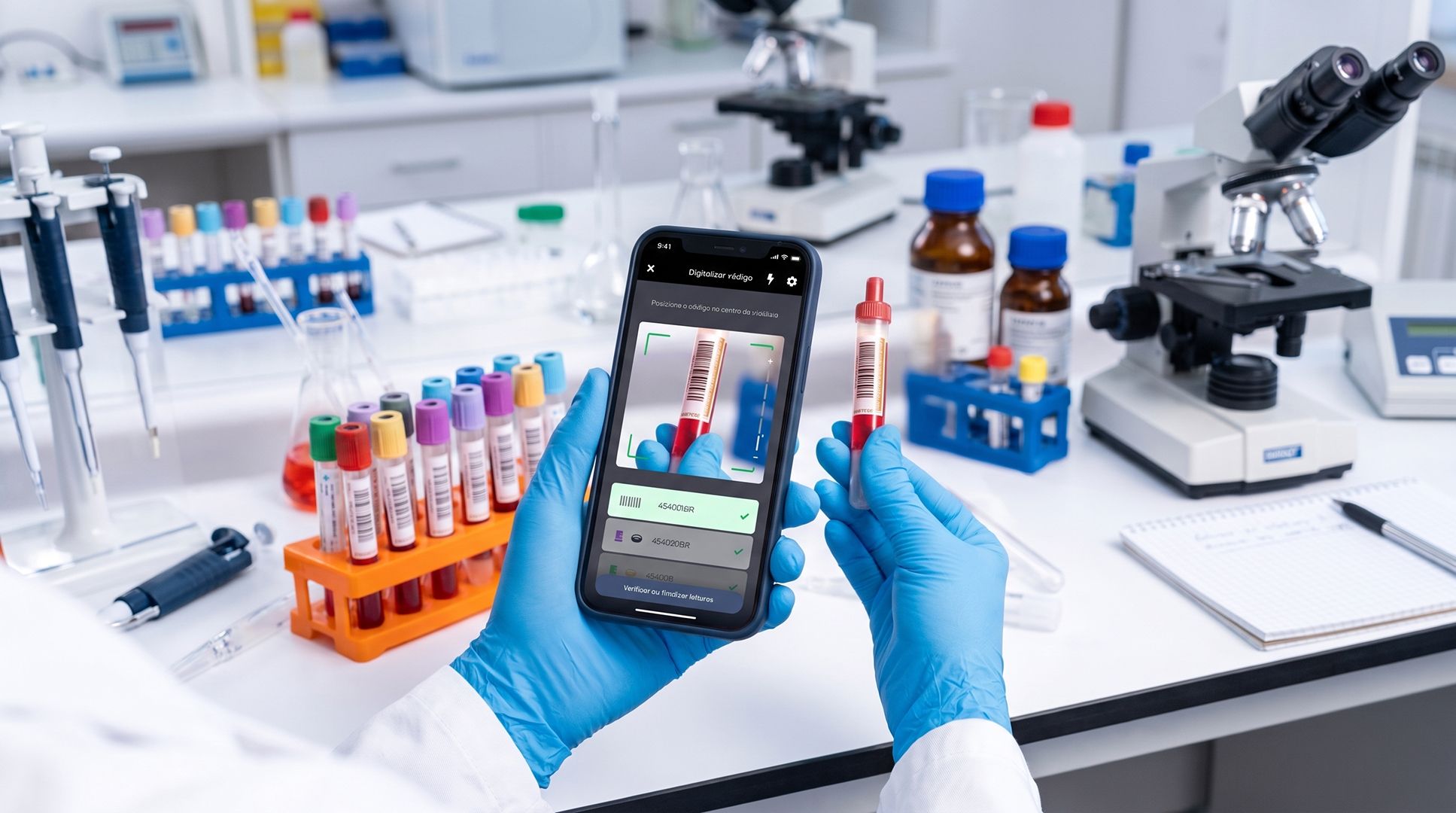
A pioneering lab-traceability app redesigned in 2 months, which became Greiner Bio-One's first SaaS product. Labs reach 90 to 95% traceability with 80 to 90% fewer pre-analytical errors, in 4 language markets.
Project context
- Client
- Greiner Bio-One, a global developer and maker of products for preanalytics, bioscience and diagnostics, present in more than 100 countries, served through Diletta Solutions.
- Segment
- HealthTech · preanalytics and laboratory sample traceability.
- Stage
- An enterprise company redesigning a pioneering product it already had in the field.
- Business model
- B2B SaaS, with subscription plans from BRL 200 to BRL 990 a month.
- Target audience
- Laboratories as the subscription buyers, and the lab technicians who collect and track samples as the app's users.
- Role and responsibilities
- Product Designer. Owned research, user flows, interface and design system, and validated them through usability testing with lab technicians, working with the PM and the mobile developers.
- Team
- A product manager, a UX designer, two mobile developers and me.
- Period
- 2022, at Diletta Solutions. Redesigned in 2 months and launched the same year.
Challenge
A pioneering app that no longer met the regulation, the way technicians worked, or what a global company needs to sell a product.
Regulation
The app didn't meet the new requirements of ISO 15189 and RDC 786 / PALC. Its data capture didn't close the traceability chain an audit demands, so labs kept compliance in a parallel record.
Real workflow
The interface didn't follow the technician's actual routine, where one badly designed interaction costs a lost sample and a new collection from the patient.
Context of use
It assumed a technician at the bench with a network, and ignored home-care collection and HUB logistics, where connectivity isn't guaranteed.
A product to sell
It lacked what turns an internal app into a product a global company can sell: multilingual support, a credible professional interface and a subscription model.
Key actions
Regulation turned into product
Interviews with stakeholders and users translated ISO 15189 and RDC 786 / PALC into design requirements, with broader data capture: technician ID, collection time and patient feedback.
Flows that follow the collection
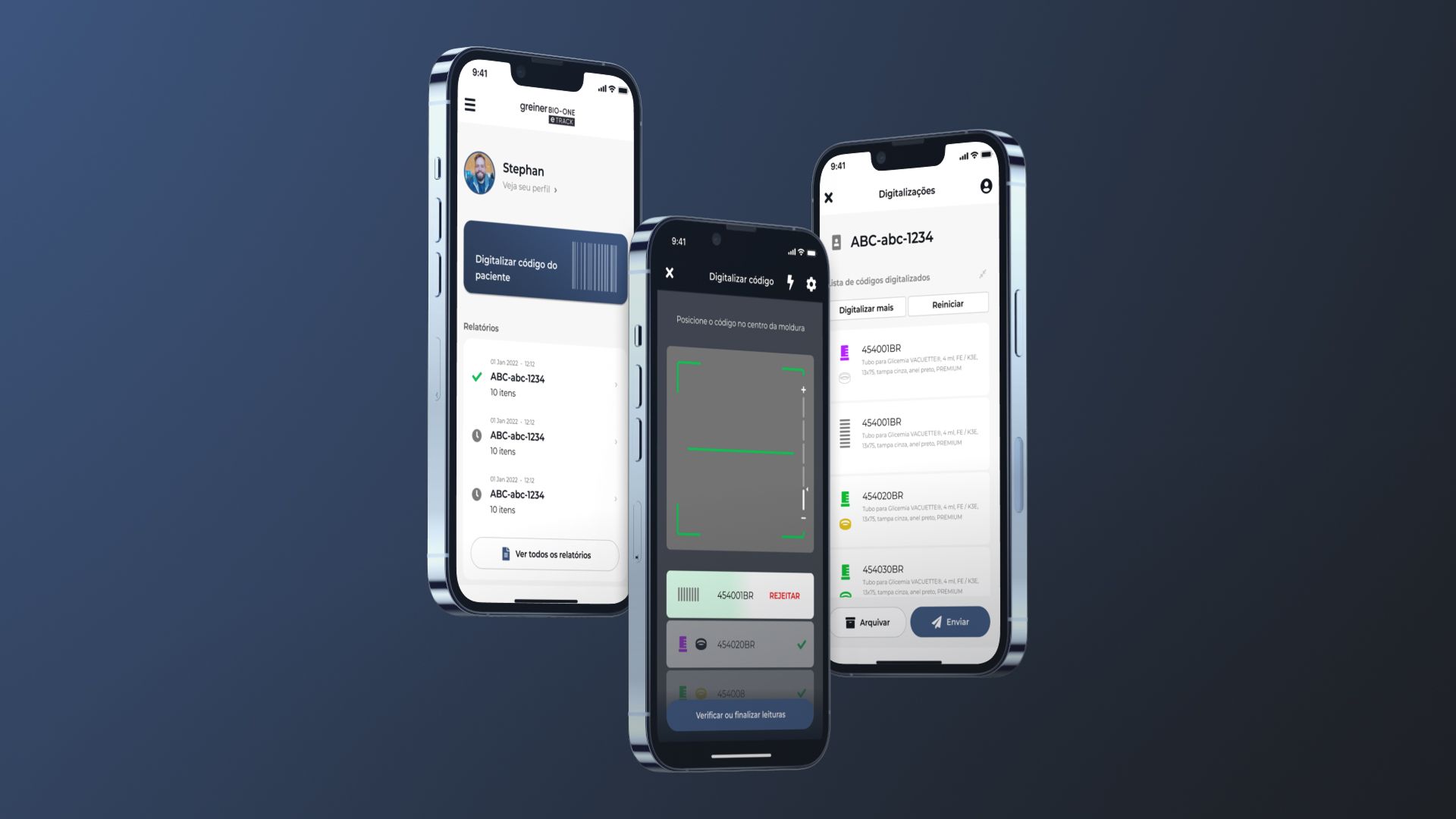
Navigation built from the technician's real sequence of work, with every flow prototyped, including the exception paths of code scanning and item checks.
Home care and HUB as first-class contexts
Offline-first behavior with a "send later" queue, including the waiting, confirmation and resend states.
One design system on Material Design
A single decision that gave visual consistency, professional credibility and production speed inside the 2-month window.
Tested with lab technicians
Usability tests confirmed the extra records the standard requires didn't slow the work down, and the flows that broke were adjusted.
Multilingual from the structure up
Languages built into the interface structure and the flows rather than translated at the end, plus documentation of flows and system for the team to continue.
Impact
- 2 days
- to prototype the whole app
- 2 months
- from brief to the delivered redesign
- BRL 200 to 990
- monthly plans in Greiner Bio-One's first SaaS model (2022)
- 90 to 95%
- sample traceability
- 70 to 80%
- of RDC 786 compliance tasks automated
- 80 to 90%
- fewer pre-analytical errors
- 20 to 40%
- higher sample-collection efficiency
- 4
- language markets: Portuguese, English, Spanish and German (2024)